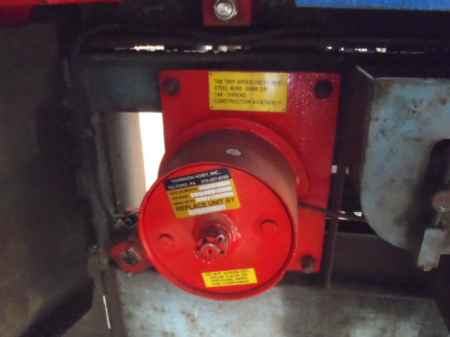
Below are some pictures of the bottom wheel/tailend sheave. While there was some paint slopped on there , I feel pretty confident that the bolt through that bottom pulley was always tight and not allowing free movement in the slot. Supporting that proposition, when my company was spending 30+ minutes/most of the annual inspection time trying to make the overspeed safety activate (again, I don't know the method, I was in the adjacent office, not by the elevator, hovering over them), they didn't mess with the bolt on that tailend sheave. I was pretty sure of that from listening, plus the paint on that bolt head was undisturbed, unlike when I loosen it up to test it out last night.
When I got the bolt loose enough, the pulley was relatively free in the slot. Once it was though, there is no natural weight pulling it down.. it just sort of hangs there and while it seemed pretty free, making it go down and very tight was tricky to figure out how to do-- I may go back, leave the bolt just barely loose and tap the bolt head and double-nut end ends down little by little with a block of wood.
Important:
Once again, my elevator company has claimed that the cable shortening proposal has nothing to do with the overspeed safety activating. They claim that they fixed that fault the day of the inspection and that separately, this cable issue was observed. My best guess, actually, is they didn't want to loosen and move the pulley down (maybe a little too much work day of inspection.), then were dissastified with that 1hr service call and would rather charge $2000 to shorten the cable... as how can the cable tension not be related to the overspeed functioning properly. Also, by the way, remember this unit is extemely low usage... so how much can this cable stretch with little tension or weight on it... and I feel confident that re-tightening by relocation of the pulley within those few inches to the floor that are there will keep this thing tight for a long time.. .then maybe a cable tightening is in order after one more adjustment down...and then I can find out if it really is a $2k job. Again, there is no weight on that bottom pulley, so I don't see why that bolt would be normally loose in the slot.
Once again, thanks to you all, I appreciate it very much.
http://s234.photobucket.com/user/deanm11/media/Sheave1.jpg.htmlhttp://s234.photobucket.com/user/deanm11/media/Sheave2.jpg.htmlhttp://s234.photobucket.com/user/deanm11/media/Sheave3.jpg.htmlhttp://s234.photobucket.com/user/deanm11/media/Sheave4.jpg.htmlhttp://s234.photobucket.com/user/deanm11/media/Sheave5.jpg.html