itsallgood, thanks for the suggestion. Will do.
So far, we have done the following-
Completely reset and calibrated loadweighing.
Set resolver angle.
Verified tach polarity, and resolver polarity.
Checked tach voltage, and adjusted tacho pot.
Dumped the drive parameters, and reloaded them.
Shaft learn.
Adon learn.
Adjusted both brakes to about .002".
Adjusted brake switches.
Tried swapping brakes.
Checked dead zone.
Checked limits, just for good measure.
Cleaned brake drum at great length, but could use even more. Odd.
Tried running it up at high speed twice, then dropping the brake, to burnish it, burn off any contaminants.
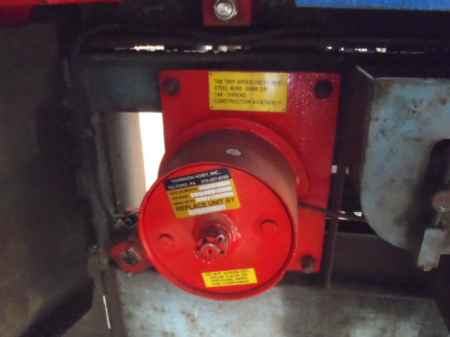
Today, I checked the brake really up close and personal, and found that when you're on car top inspection, going up, and you release the buttons, the main brake sets right away, but the rotor moves like an inch or an inch and a half, before stopping. At the suggestion of a friend, I cleaned the brake drum with denatured alcohol, and man was it dirty. The dirt just kept coming off, and coming off. I wondered when a clean rag would come out clean, but it never did. So I quit cleaning the drum for a bit, and looked at the shoes, to see if they were oil soaked, and maybe that was leeching crap back onto the drum. But the shoes looked typical, just like the other good running cars.
If I put 2000# in the car, it comes into floors perfectly, and stops perfectly, and does not relevel at all.
But with an empty car, the current state of affairs is that it comes into any floor perfectly, (up or down), levels in perfectly, comes to a complete stop as it should, (61U and 61N are high at this point), but then as the main brake sets, the car drifts up like 1/2, then it is out of the dead zone, so it wants to relevel downward. Which it does. Yes, indeed, it relevels perfectly, comes to a complete stop for the second time, perfectly level, but then again, as the main brake sets, the car again rolls up and out of the dead zone. It kinda makes you wanna reduce the main brake to .0005" gap! The fact that it comes in so controlled, so smooth, dials itself into floor level so very finely, and comes to a complete, dead stop, exactly at floor level, each and every time, tells me that this issue isn't a dynamic issue related to the S-curve, dynamic braking, loadweighing (with one small caveat), limit switches, resolver angle, tach, etc, etc. All those things will affect the way the car runs, and may affect the way it stops, sure. But this car we're dealing with here, runs perfectly, slows down perfectly, levels perfectly, stops perfectly, perfectly level with the floor, each and every time, any direction, all floors-
Then it rolls up out of the dead zone, while the main brake sets!
This issue appears to have nothing to do with any dynamic forces/adjustments during the run. It runs perfectly. Just doesn't "stay put" while the main brake sets!
I did notice that a V3F18 drive haas a brake timer parameter, 6-43, but the V3F25 doesn't have this. I was really hoping there would be a parameter that would hold torque on the motor for a few milliseconds, until the main brake is well and truly set. But there isn't such a parameter, or at least it's not field adjustable. I was really wondering what the timing relationship was, between the drive shutting off, (no motor torque), and the de-energizing of the main brake.
I wanted to investigate the timing relationship between the motor torque, and the operation of the main brake, to see maybe if our "bad" car has too much time between the cessation of torque, and the de-energizing of the brake. So I took my trusty oscilloscope, (BK PRecision, $200 Korean special build), and went over to a good running car. I hung one probe on the main 201 contactor coil, and the other probe on the main brake coil. First off, the brake is only half wave rectified DC, and not even filtered, which sounds pretty rudimentary these days...but onward-
Watching the dual traces, it was clear, that the main contactor stays energized for like a half a second, after the main brake coil de-energizes. Well, of course. How else are you going to fight gravity from pulling the cwt downward, which pulls the car upward, until the brake has set? I knew there had to be a delay, where the motor torque holds the car, while the brake completes the mechanical motion of setting. Yes, the gap is very tight on these brakes, but it is not "0". The drive and the main brake do not de-energize simultaneously, no, rather the motor stays up for a bit, giving the main brake a few milliseconds to set.
Tomorrow, I check the "bad" car. If the timing is identical, then it's back to the brake. Full disassembly, check shoes wear pattern, look for soaked/contaminated brake shoe material, cleaning, lubrication where appropriate, and re-adjustment. Maybe scuff the shoe surface with some emery cloth.