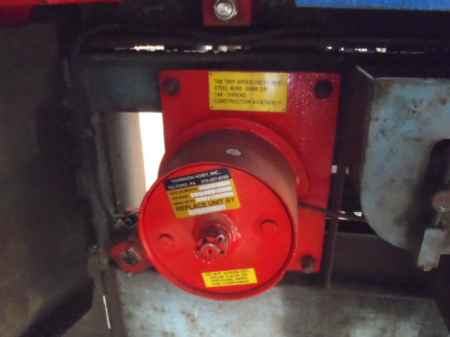
I'm using the Stop Loss unit. It's da bomb!
Note that when doing the vertical adjustment or test on the Kone ECO 3000 escalators, there is sort of a lever-action, between the floor plate pivot point, and where the force of a stuck foot would contact the leading edge of the combplate, and deflect it upwards. If you were to remove the combplate during testing or adnustment, this would make the "lever" only half as long. If you apply your testing force at the edge of the landing plate, (where the combplate attaches), you would be misadjusting the action. You would need twice the force to make the switches trip, because the "lever" is only half as long, with the combplate removed. This does not truly represent the vertical actuation of the combplate switches if struck by a foot or shoe.
In contrast to the above, When the combplate is installed, the "lever" is now approximately twice as long, requiring half the force to trip the switches. IMO, this is how the force should be applied during testing and adjustment. The reason being, that this is how the unit actually runs, when completely assembled, and the public is using it.
I took an old combplate, and modified it just a bit, so that the Stop Loss tool applies it's force to the leading edge of the combplate, as closely as possible representing the actual conditions during normal usage. The specially modified combplate stays with the Stop Loss tool for all testing and adjustment.